

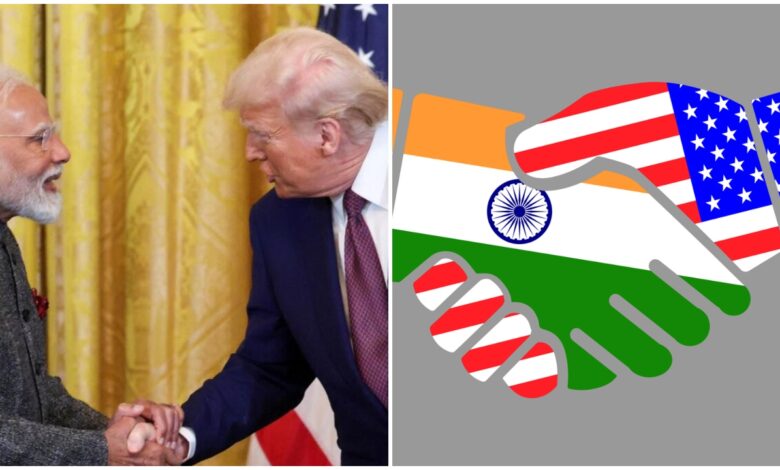
Is the “big, beautiful” US-India trade deal slipping away? With only a few days to go before a 9 July deadline imposed by the US President Donald Trump administration, hopes of securing an interim trade agreement between Delhi and Washington remain alive but increasingly mired in tough haggling.
Even as White House Press Secretary Karoline Leavitt suggested the agreement was near at hand. Indian Finance Minister Nirmala Sitharaman optimistically declared Delhi would embrace “a big, good, beautiful” deal – in reaction to Trump’s statement of a trade agreement with Delhi on Tuesday that is in the works and would “open up” the Indian market – negotiators are stuck in hard bargaining.
Sticking points continue to be key, notably on farm access, car parts and Indian steel tariffs. Indian trade negotiators have prolonged their Washington stay for the next round of negotiations, even as Delhi gives signals of “very big red lines” on farm and dairy shielding, and the US insists on broader market access. The mood is still upbeat, but the window of opportunity to agree is narrowing.
The next week may decide whether India and the US accept a minimalist ‘mini-deal’ or leave the negotiating table – for the moment, at least,” says Ajay Srivastava, a former Indian trade negotiator who heads Global Trade Research Initiative (GTRI), a Delhi-based think tank.
That depends on a couple of flash points – none more acrimonious than agriculture. There are two genuine hurdles to reaching a preliminary accord. First in line is US access to India’s market for basic agricultural goods. India will have to guard its basic agricultural sector for economic as well as political motives,” Richard Rossow, who monitors India’s economy at Washington’s Centre for Strategic and International Studies, said to the BBC.
Washington has long pressed for wider access to India’s farm market, regarding it as a large untapped opportunity. India has fought hard to keep it out, in the name of food security, livelihoods and the interests of millions of small farmers.
Mr Rossow explains, “The second issue is India’s non-tariff barriers. Challenges such as India’s growing list of ‘Quality Control Orders’ (QCO) are important barriers to US market access and could be difficult to meaningfully address in a trade agreement”.
The US has objected to India’s so-called increasing and onerous import-quality regulations. More than 700 QCOs – under the “self-reliant India” initiative – are designed to keep out low-quality imports and encourage indigenous manufacturing.
Suman Berry, a senior member of a government think tank, Niti Aayog, has also referred to these regulations as a “malign intervention” that limits imports and increases costs for Indian medium and small-scale industry.


