

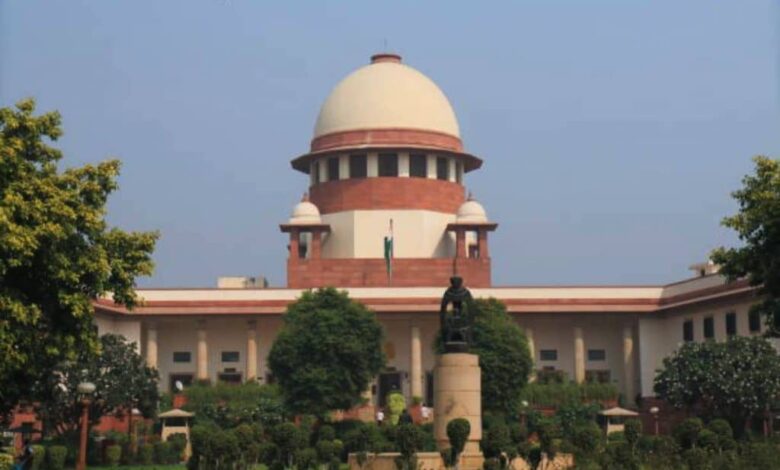
The Supreme Court has faced increasing recent criticism, with the latest coming from BJP MP Nishikant Dubey, who had a scathing attack, after earlier statements from Vice President Jagdeep Dhankhar. Dubey, a Godda MP from Jharkhand, used terms such as “anarchy” to describe the Supreme Court and blamed it for “stirring religious wars.”
The increased rhetoric comes in the wake of Dhankhar’s assertion that “Article 142 has become a nuclear missile against democratic forces, at the disposal of the judiciary 24×7.” This came after a Supreme Court ruling that set a deadline for action on pending bills by the President and Governors.
Defying the judiciary’s authority, Dubey stated, “How can you give directions to the appointing authority? The President appoints the Chief Justice of India. The Parliament enacts the law of this country. You will instruct Parliament?. This is to say that you wish to guide this country towards anarchy.” His remarks reflect concerns over the growing powers of the judiciary.
Dubey continued to castigate the Supreme Court, arguing, “If one has to approach the Supreme Court on every matter, then Parliament and State Assembly should be closed.” His remarks have been strongly denounced by opposition Congress party, which accused ruling party of making an attempt to “dilute the Supreme Court.”
Congress leaders Manickam Tagore and Jairam Ramesh condemned Dubey’s comments as defamatory and part of a broader attack on the judiciary. Ramesh referred to the targeting of the Supreme Court in the context of current controversies over electoral bonds and the Waqf (Amendment) Act, 2025.
The BJP, with criticism both from within and outside its ranks, attempted to distance itself from the controversial remarks. BJP leader JP Nadda released a statement stating that the BJP does not agree with the comments made by Dubey and Sharma, reaffirming respect for the judiciary as a foundation of democracy.
Dubey’s comments surface as the Supreme Court is hearing pleas challenging the constitutionality of the Waqf Act with the Centre promising not to denotify any clause or include non-Muslim members on the board. The law, according to critics, violates constitutional freedoms like equality and religious freedom.
These rising tensions are proof of mounting discontent among the executive and legislative branches and the judiciary, for existing rulings by the Supreme Court challenge actions by the state and federal government.


