

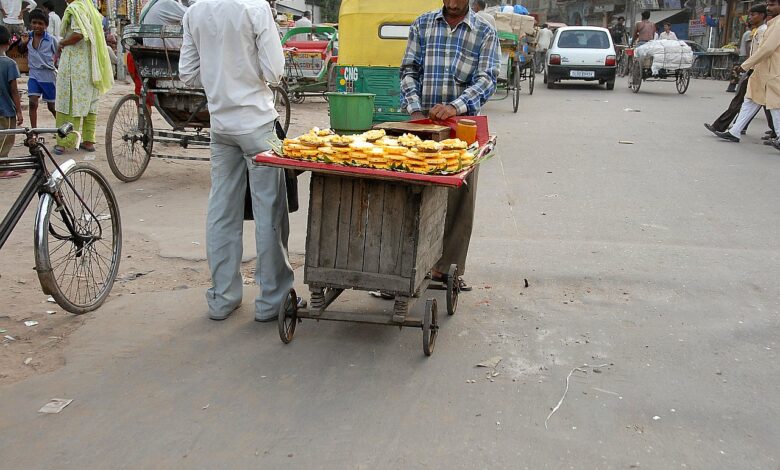
The economic contributions of these street vendors should be acknowledged by civic authorities and incorporated into urban planning. In the late evening of May 17, a team of New Delhi Municipal Council officials descended on Sarojini Market, well-known for its stylish clothes at affordable prices, and demolished over 150 shops.
It was part of the high-profile, aggressive demolitions of street vendors that the Delhi authorities have stepped up since April. Close to 20,000 stalls in Delhi have been dismantled since May, the National Association of Street Vendors of India says. Most of the vendors who have been evicted own “certificates of vending” – legal papers proving their right to sell on certain plots of land.
The deluge of evictions of street vendors in Delhi has set off a controversy surrounding the livelihood rights of informal workers. Legislative protections were established over a decade ago, but Delhi’s street vendorsDelhi CM rallies support for INDIA alliance targets BJP find themselves in an increasingly precarious position. The growing tension between urban growth and the right to livelihood has raised serious questions about Delhi’s commitment to fair and inclusive development.
Street vendors are a significant distribution channel of basic goods and services in most cities of the world. Appreciating their role in the economy, the government of India in 2014 enacted the Street Vendors (Protection of Livelihood and Regulation of Street Vending) Act to safeguard vendors’ rights as well as legalize their operations.
Yet, in spite of the law that gives a degree of protection to vendors under this act, Delhi has seen numerous occasional evictions over the past five years.
Different reasons have been given by the officials: that they are removing encroachments or disinhibiting “illegal structures” from public spaces, that this is being done in order to implement beautification schemes, that the vendors were located on railway land, that the area which they occupy is being needed for widening the roads.
These enforcement strategies are in direct conflict with the clear protections ensured through the 2014 act, which bars eviction until due surveys are conducted and town vending committees are up and running.
The committee is a statutory committee tasked with the issuance of vending certificates, determining designated vending areas and resolving conflicts. It is composed of civil society representatives, government officials and street vendors.
In Delhi, although the Act was notified in May 2014, the rules and schemes needed to bring it into effect were not notified until April 2019. A number of vendors have also said that the regulations are being misinterpreted.
One of these is the “30-minute rule” which is supposed to ensure that mobile vendors spend only half an hour at a particular location. The authorities are, however, said to be using the rule on stationary vendors and the ones who sell at fixed weekly markets like Budh Bazaar, to whom it was never applicable.


