

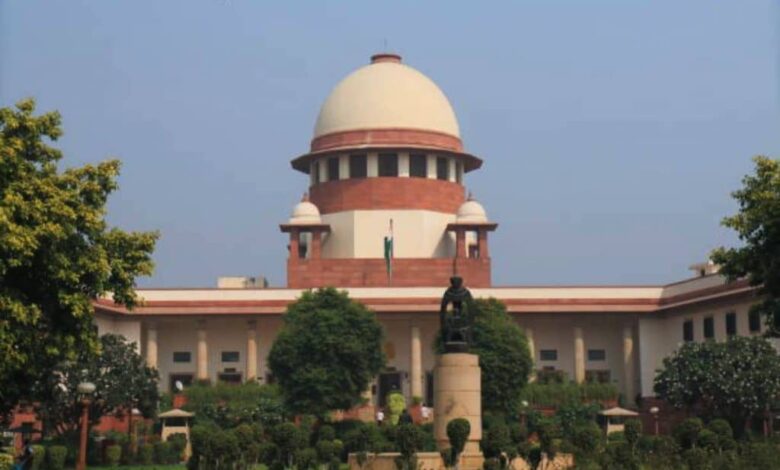
In a significant ruling, the Supreme Court recently said that forcing a marriage to continue despite persistent unhappiness and conflict defeats the very object of the institution. The observation came while dissolving a matrimonial alliance from 2002 involving a software engineer couple.
A bench of Justices Vikram Nath and Prasanna B. Varale observed, “Marriage is a relation of mutual trust, companionship, and sharing of life. If the basic ingredients are not there for a long period, the matrimonial bond becomes a mere legal formality without contents.” The court also observed that continuous separation, coupled with inability to reconcile, is one of the essential factors in matrimonial litigation.
The Supreme Court, while upholding the judgment of the Madras High Court in granting divorce to the respondent-husband, dismissed the pleas of the appellant-wife as devoid of merit. The court ordered the husband to pay permanent alimony of Rs 50 lakh to the wife and another Rs 50 lakh for their daughter born in 2003.
The Supreme Court based its decision on the grounds of cruelty, long separation, and irretrievable breakdown of marriage. The bench explained that the long separation and evident animosity between the parties made the chance of reconciliation untenable.
The trial court had dismissed his divorce petition, which the first appellate court had confirmed on the ground that the wife was willing to live with him. Later, the husband, alleging that the wife had subjected him to both mental and physical cruelty, such as filing false cases and abandoning the matrimonial home, approached the High Court on grounds that these actions caused substantial mental distress and contributed to the breakdown of the marriage.
The High Court granted merit to the husband on grounds of cruelty and desertion under Section 13(1)(ia) and (ib) of the Hindu Marriage Act, 1955, since his wife’s complaints were false, and her reluctance to come back was causing a lot of mental torture to the husband. Besides this, separation for so long an period amounted to desertion, which has dissolved the marriage.
The appellant-wife, in appeal against the impugned judgment and order of the High Court, pointed out that it had exceeded its jurisdiction in holding the irretrievable breakdown of marriage, which was not urged before courts below. She has put forth arguments that such a conclusion goes against the settled rule and claimed that her motives were more to maintain respectability in her family, rather than for pecuniary benefit.
On the other hand, the respondent-husband reiterated that the marriage had irretrievably broken down and nothing was to be gained by further legal proceedings. He contended that since the wife’s actions had caused him immense agony, it had become impossible to reconcile with her.
On careful consideration of the evidence and arguments advanced, the Supreme Court held that grounds of cruelty, long separation, and irretrievable breakdown of the marital tie were clearly proved. Citing the cases of NG Dastane vs S Dastane (1975) and V Bhagat vs D Bhagat (1994), the bench explained that continuous acts of cruelty make it impossible for the spouses to live together. It also referred to K Srinivas Rao vs DA Deepa (2013) to show that long separation gives rise to a presumption of irretrievable breakdown.
While the Hindu Marriage Act does not provide for irretrievable breakdown as a statutory ground for divorce, the bench, in exercise of powers under Article 142 of the Constitution, passed an order providing relief since to continue the marriage any further would only perpetuate hatred and litigation causing injury to both parties.
The court observed that the appellant’s acts, such as filing false criminal complaints amount to mental cruelty and have caused immense emotional distress to the husband and the relationship is irreparably damaged. Finally, the bench ruled that the marriage had lost its essence, continuation of it serves no purpose, and dissolution of marriage was in the interest of both parties.


