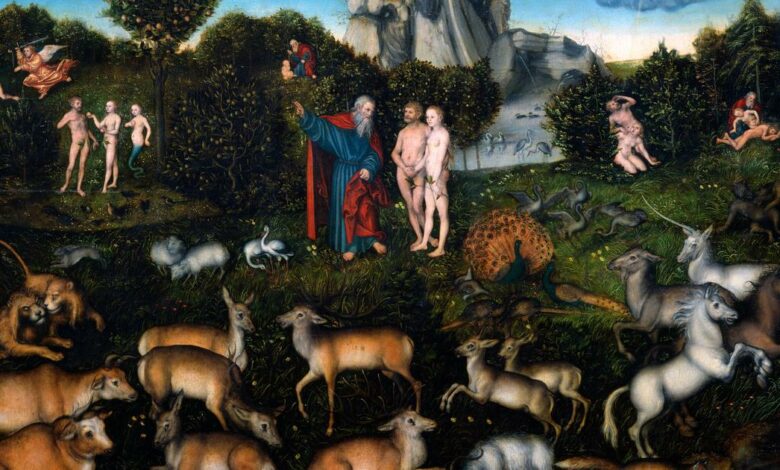
A passage from ‘The Cave of Echoes: Stories About Gods, Animals and Other Strangers’, by Wendy Doniger. To suggest that human beings are sacrificial victims like other animals, or to suggest that no human beings nor any animals are sacrificial victims, is, to some extent, to suggest the belief that animals are non-other: that we are like them.
The refusal to kill and/or consume animals is, in part, a reflection of the idea that animals are non-other and that consuming them is thus a form of cannibalism. The idea that animals are so other that they are gods, however, provides another swing of the pendulum and generates a justification for consuming such animals after all – to consume them ritually.
It is helpful to place animals on a spectrum of otherness; within any culture, there will be different narratives about animals at different levels. Within our culture, horses and dogs are first, the animals most like us, with whom we have rather sophisticated systems of communication that lead us into the illusion that we can think like horses.
Then there are the wild animals that appear to be very like us, such as the bears and monkeys of the Ramayana who talk a human language and walk upright. Then there are the wild animals unlike us but still mammals, such as lions; and then there are the animals which we consider completely unlike us, such as fish.
Now we are aware that whales and dolphins can communicate not just to each other but to us. This knowledge makes real the legend of the fish and the bridge and leads us to wonder if maybe one-day whales will share their myths with us.
But because dolphins are not fish but resemble fish, and because they are animals but communicate with us in a way other animals do not, they straddle in two ways the line between our own mammal and fish categories and thus challenge our notion of what it means to be human.
This explains, in part, why some are hesitant to label what dolphins do “speech.” And indeed, the language humans use to communicate with dolphins is not the language in which dolphins communicate with each other nor the language in which we communicate with each other – it is a Rosetta stone language. But it is a language, and it bridges us to the fish.
The idea that all animals can in some way be less other than they appear to be is the origin of the ever-magical myth of a magic time place or person that dissolves the distinction between people and animals.
The period of this animal paradise has a close equivalent in the myth which speaks of the period when gods roamed amongst mortals or mortals amongst gods.
The location, as the magic location in the Looking-Glass forest where objects lack names, where Alice might stroll with her arms around the neck of a fawn, is similar to the high mountains where men live among gods.
The specific person with these unique abilities has a counterpart in the mythology of a specific individual (usually a priest or a shaman) who possesses a unique talent for dealing with the gods. Well-known instances of such individuals who coexist peacefully with beasts would involve Enkidu in the Gilgamesh epic, Francis of Assisi, and the numerous mythological children who are brought up as cubs by wild beasts, such as Romulus and Remus, Mowgli, and Tarzan, such as Pecos Bill (nursed by a puma) and Davy Crockett (reared with mountain lions).
It could be used to cover children born and brought up among household animals: Oedipus, brought up among sheep, and Jesus, born in a manger. TH White (once translated a medieval bestiary) envisioned King Arthur’s education by Merlin the Wizard as being done among ants and geese and owls and badgers, whose language Arthur understood.
Our list could also feature a band of women whom we shall shortly meet, the Bacchae, who nurse at their breasts fawns or wolfcubs, and snakes whose cheeks are licked. The Bacchae must forsake their own nursing infants and butcher tame cattle; only in the wild do they feel at home.
The myths wherein we use the animals’ language are myths about the friendships with the wild creatures that we typically hunt, but not with the same ones that we offer as sacrifices.