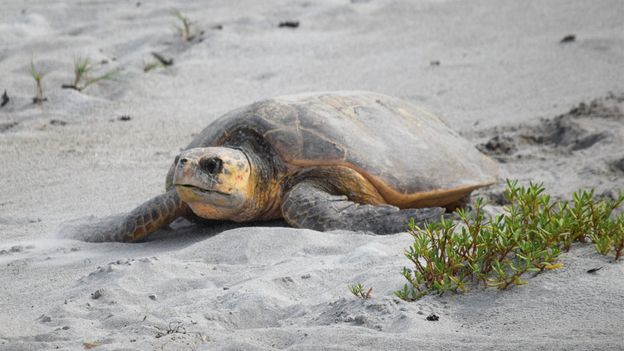
The state is famous for manatees and alligators, but the world’s most significant sea turtle sanctuary lies quietly within 90 minutes of Orlando’s theme parks. From a vantage point above Melbourne Beach, Florida, dunes, I looked out at the Atlantic Ocean and saw at once a pair of green sea turtles swimming in the ocean close to shore. Another appeared in sight; then another.
I tallied five couples in a couple of minutes. On the beach, a small cluster of individuals were sunbathing. I wondered if any of them had any idea that they were probably standing above hundreds of sea turtle nests at that very instant.
They might not have even realized that they were within the Archie Carr National Wildlife Refuge, one of the world’s most significant sea turtle breeding grounds, says David Godfrey, the Sea Turtle Conservancy’s executive director.
Florida is famous for exotic underwater experiences such as manatee swimming and dolphin sightings, but every year, thousands of loggerhead and green turtles and dozens of leatherback turtles travel across the world’s oceans to breed and nest here.
Yet the refuge – covering 33km between two unnamed barrier islands, stretching between the towns of Melbourne Beach and Wabasso Beach – is no remote space; it’s a coastal destination filled with rows of pastel-coloured beach houses just 90 minutes from the tourist-thronged theme parks of Orlando.
The land was already in private hands when the refuge was created in 1991, so the area is now a combination of protected wildland and built-up land. Preservation works here not by isolating human beings and nature, but by permitting their existence together in harmony. Interested in this interaction, I’d made the trip to Melbourne Beach to take part in a sea turtle nesting tour.
Since turtles tend to nest and hatch at night, our tour started at about 21:00 in an auditorium, where we learned about the species as trained scouts slowly and quietly scouted for turtles on the beach. We eagerly but patiently waited, knowing that we would not go to the shore until a turtle had emerged from the sea, made a nesting hole and stood guard over it.
After being prepared to lay the eggs, the turtle would be in a state of trance whereby we could observe her peacefully without disturbing or frightening her. They don’t want to be observed [for fear of predators]\”, said Nichole Perna, land management specialist for Archie Carr’s visitor centre, describing how bright lights can “deter [them] from nesting”.
Driven by an ancient compulsion, female sea turtles tend to nest every two or three years on the same beach upon which they emerged from their eggs, or in the vicinity of it.
But they might not be able to nest if a beach has gotten too bright or noisy, or if barriers – man-made constructs such as breakwaters and groynes erected to mitigate coastal erosion – prevent them from accessing the sand. Blair Witherington, a research scientist at Inwater Research Group, said that if that’s the case, the turtles “will shed their eggs in the water.”.
These won’t make it. And what of eggs that do get successfully laid: just one in 1,000 survive to adulthood. Hatchling death is caused by many dangers; “chief among them are light pollution and coastal armouring,” stated Witherington.
Lights will confuse the hatchlings and not let them go into the sea,” and structures keep them penned in. It’s little wonder six out of seven species of sea turtles are listed as vulnerable, threatened or endangered.