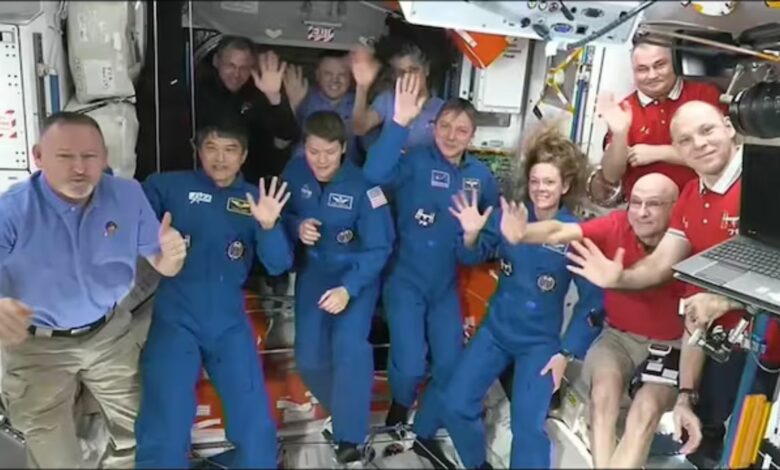
NASA astronauts Sunita Williams and Butch Wilmore will initially be transported to their crew quarters for a few days of medical checks, as is standard for astronaut returns, before flight surgeons sign off they can return home to their families
NASA astronauts Sunita Williams and Butch Wilmore are heading home to Earth after leaving the International Space Station early on Tuesday. Williams and Wilmore, two experienced NASA astronauts and retired US Navy test pilots, are returning home aboard their Crew Dragon spacecraft with two other astronauts, American Nick Hague and Russian cosmonaut Aleksandr Gorbunov. They detached from the orbiting laboratory and began their 17-hour journey to Earth.
The four-member crew, officially part of NASA’s Crew-9 astronaut rotation mission, will splash down off the coast of Florida later on Tuesday at 5.57 pm ET (3.27 am IST on Wednesday, March 19). NASA officials said the weather for the splashdown was to be “pristine”.
Wearing re-entry suits, helmets and boots, the astronauts were observed on NASA’s live coverage laughing, hugging and taking photos just before they were closed into the capsule for two hours of last pressure, communications and seal checks.
Williams and Wilmore will initially be flown to their crew quarters at NASA’s Johnson Space Center in Houston for a few days of health checks, according to routine for astronaut returns, before flight surgeons clear they can return home to their families.
This is particularly because space living for months can impact the human body in various ways, ranging from muscle wasting to potential vision loss. Astronauts have to retrain their bodies under NASA’s 45-day post-mission rehabilitation program. Earlier this month, Williams said she was eager to get back home to visit her two dogs and family. “It’s been a roller coaster for them, probably a little bit more so than for us,” she had said.
Williams and Wilmore exceeded the normal six-month ISS tour but are sixth in US records for single-flight length. Frank Rubio is first with 371 days in 2023, with the global record still with Russian cosmonaut Valeri Polyakov at 437 continuous days on the Mir station.