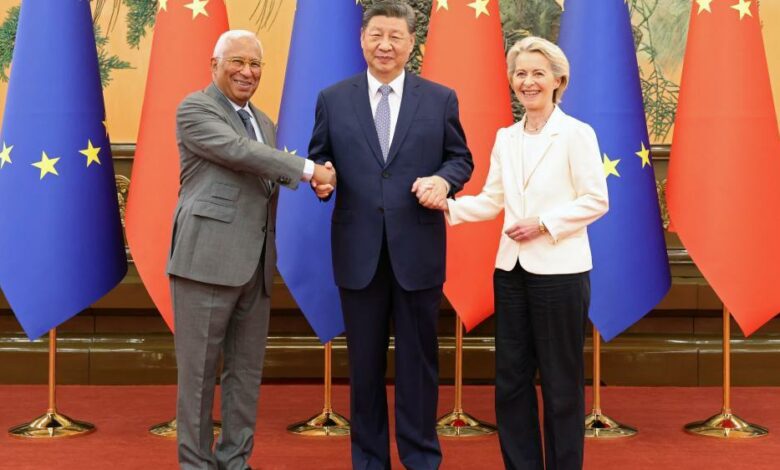
EU-China relations have come to an “inflexion point,” European Commission President Ursula von der Leyen has warned her Chinese counterpart, Xi Jinping, during a day-long summit in Beijing.
“As our co-operation has intensified, so have imbalances,” von der Leyen added, referencing the European Union’s vast trade deficit with China. She further cautioned that China’s relationship with Russia was now the “determining factor” in its relations with the EU.
Xi asked EU leaders to “properly manage differences”, stating “the current challenges for Europe do not come from China. Earlier in the year, there were hints that a Trump presidency would be good for the EU and China as they should be able to find common ground, but instead, relations have become more strained.
The EU’s 27 member states are facing similar strains as China, not least of all the tariffs slapped on their exports to the US. But despite that, hopes were low that anything meaningful would come out of the one-day summit, reduced in length at China’s request.
In a meeting in Beijing’s Great Hall of the People, Von der Leyen and European Council President António Costa urged both sides to come up with “real solutions”. It is essential that China and Europe recognise our respective interests,” von der Leyen said. Xi urged “mutual trust” with EU nations during the meeting, state news outlet Xinhua reported.
“Increased competitiveness is not created by erecting walls or obstacles, as decoupling and cutting off the supply chain will only lead to self-isolation,” he added. The EU had a €305.8bn ($360bn; £265bn) trade deficit with China last year, a figure that has doubled over the past nine years. The EU has chastised China for overcapacity in industry and placed tariffs on Chinese electric vehicles.
Rebalancing will mean expanding market access for European firms in China, liberalising export controls and minimising the effects of overcapacity, von der Leyen said. China’s foreign ministry stated after the meeting that Beijing is willing to cooperate with interested countries to “improve dialogue on export controls. Von der Leyen and Costa also stated that they had pushed China to employ its influence to bring an end to Russia’s war in Ukraine.
“How China still engages with Putin’s war will be a decisive point for our relations in the future,” von der Leyen said during a news conference after the summit.
Soon after she arrived in Beijing, von der Leyen called the summit a chance for both sides to “advance and rebalance” relations. I’m convinced there can be a mutually beneficial co-operation. One that can define the next 50 years of our relations,” she posted on X.
Her remarks chimed with the image of optimism that both sides had presented before the summit. EU officials had indicated that they were prepared for candid discussions, while Chinese officials had presented it as an opportunity for enhanced cooperation.
China’s foreign ministry had stated earlier in the week that the bilateral relationship was at a “critical juncture of building on past achievements and opening up a new chapter”.
But Xi’s refusal to accept an invitation to Brussels at the start of this year, followed by his appearance in Moscow in May at Russia’s traditional World War Two victory parade, set off on the wrong note.
Engin Eroglu, the leader of the European Parliament’s China delegation, is convinced that an already wobbly trust between the EU and China has sunk to a new low: “In this climate of strategic distrust, the mood is tense – if not glacial.”
The most important of all the factors responsible for the loosening of ties between the two giants is the Russia-Ukraine war.
The EU’s move to slap sanctions last week on two Chinese banks for their involvement in supplying Russia irritated Beijing in the lead-up to this summit and created a forced atmosphere. China announced that it had made “solemn representations” to the EU’s trade commissioner in advance of the summit.
Also circulating are reports that Chinese foreign minister Wang Yi told EU foreign policy chief Kaja Kallas this month that Beijing did not want to see Russia lose the war in Ukraine – contradicting China’s official position of neutrality.
According to reports, Wang said that the Russia-Ukraine war would keep the US distracted from its rivalry with China – something Beijing has denied.
Kallas had previously this year referred to China as the “key enabler of Russia’s war” in Ukraine and said that “if China wanted to stop the support, then it would have an impact.”.