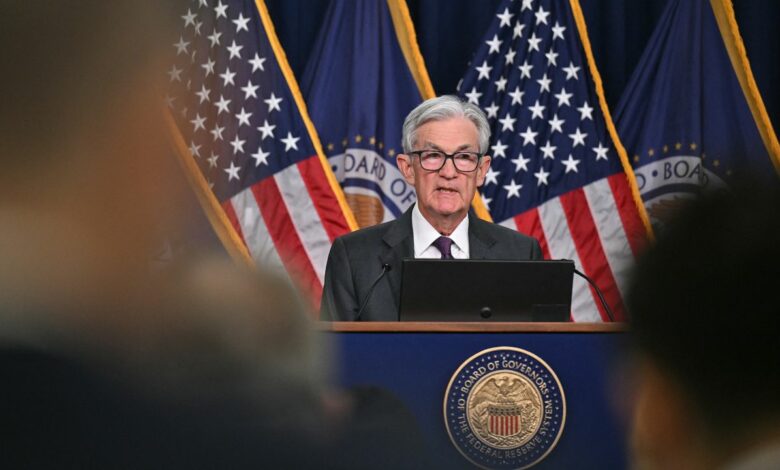
Individuals and companies in the US have confronted a maelstrom of policy upheaval in recent months. But something has remained steadfast: borrowing rates fixed by the US central bank. The Federal Reserve maintained that approach on Wednesday, holding its main interest rate steady, even as officials’ expectations for the economy darkened.
The move was the fourth in succession without action, leaving the bank’s powerful lending rate at around 4.3%, where it has been since December. That was despite predictions by policymakers that they anticipated slower growth, increased unemployment and more rapid inflation than they did a few months earlier.
Usually, the Fed reduces borrowing costs when it feels that the economy is in trouble and increases them if prices begin to rise too rapidly. President Donald Trump has repeatedly urged the Fed to reduce interest rates, as he pressures significant shifts in economic policy, including increasing tariffs on imports from across the globe.
Fed policymakers, who have the authority to determine interest rates without White House input, have expressed concern that a temporary spike in prices resulting from those new tariffs might become a more lasting issue.
Inflation, the rate of price growth, is still above the Fed’s 2% goal at 2.4% in May. Federal Reserve chief Jerome Powell explained the bank was expecting prices to increase at a faster rate in the coming months as companies begin to shift the burden of the import levies onto consumers.
“That process is extremely difficult to forecast,” he said, adding that it would be contingent on how large the tariffs are and how long they last.
That’s why we believe the right thing to do is stay where we are. He added the bank could wait, observing that the overall economy was still “solid” and the jobless rate still low at 4.2%.
However, projections published by the Fed indicated that policymakers, on average, are forecasting growth slowing down to 1.4% this year from 2.5% last year and the 1.7% they were projecting in March. The projections are for around 3% inflation, higher than the 2.7% forecast in March and an increase in the jobless rate to 4.5%.
The expectations regarding interest rate cuts over 2025 did not shift much, with most members still expecting the rates to fall just below 4% by the end of the year. However, the projections see slightly higher rates in 2026 and 2027 than had been expected.
In comments on Wednesday before the Fed’s move, Trump again criticized Powell as “stupid” and “too late” to act, while wondering if he would serve out his term.
The European Central Bank has lowered interest rates eight times since June last year. The Bank of England reduced borrowing costs last month but is likely to leave rates unchanged this week. But Isaac Stell, Wealth Club investment manager, claimed Trump might have “talked himself into a bit of a bind”, as the Fed remains wedded to its wait-and-see strategy.
“Central bankers are very keen to maintain their independence, and that means that unless there is a very strong reason to reduce they may well just remain sat on the fence,” he added. Fed interest rate decisions set the rate at which it lends to banks in the short term.
That rate in turn has a broad impact on the cost of borrowing throughout the economy, guiding what households and businesses pay for mortgages and other types of loans. At 4.3%, the Fed’s benchmark rate is still substantially higher than it was from 2008 through 2022 when the bank began raising rates in reaction to inflation.