Lawyers for Harvard University and the Trump administration clashed in a Boston courtroom as they battled over President Donald Trump’s decision to revoke billions of dollars in government funding for Harvard’s education programs.
During a hearing on Monday, the judge presiding over the case appeared dubious about the action to freeze over $2bn (£1.5bn) in federal grants for the university in an expressed effort to combat antisemitism.
Judge Allison Burroughs asked how withholding money that was to be spent on medical research would prevent antisemitism. She even referred to the government’s arguments as “mind-boggling” at some point.
Trump lawyers maintained that the cuts are warranted and needed as a measure to punish anti-Jewish prejudice. She also asked if the government felt it could invalidate funds that were allocated without offering evidence of antisemitism.
“The implications of that on constitutional law are astounding,” the judge stated, also referring to the claim as “mind-boggling. Don’t you need to prove every researcher is antisemitic, rather than a blanket charge: Harvard is antisemitic?” she asked.
The judge refused to grant an immediate summary judgment following the roughly three-hour hearing, and assured her ruling would come soon. Trump, on a post to Truth Social, called the judge biased and “a total disaster.” He speculated that she would find for the government, and promised to “immediately appeal, and win.”
Dozens of demonstrators gathered outside the court for the hearing, with signs saying “defend academic freedom” and “hands off Harvard. Trump has also hinted before that his move against Harvard is part of a negotiation tactic, once stating, “I think we’re probably going to settle with Harvard”.
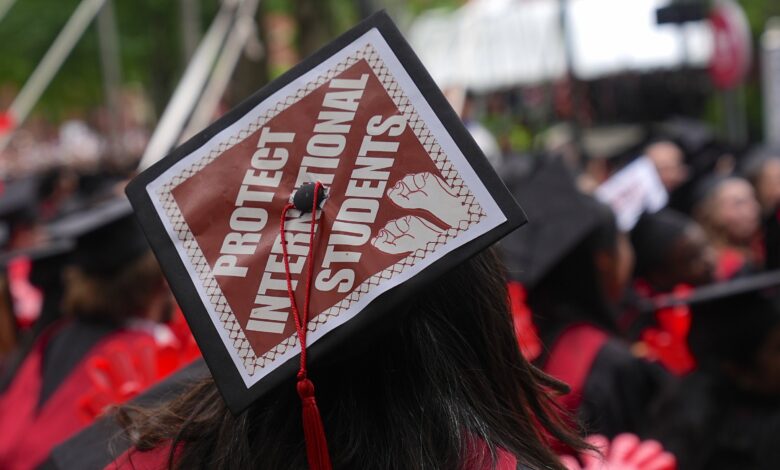
In a statement, a White House spokesperson said: “We are confident that Harvard will ultimately see the light and support the president’s vision, and through good-faith discussions and negotiations, a good deal is more than possible.”The highly anticipated case arrives as the White House also moves to bar the university from accessing a visa program that enables it to admit foreign students.
Judge Burroughs, who was nominated by then-President Barack Obama, has already issued a number of interim decisions in favour of Harvard in another lawsuit regarding the foreign student visa program.
In the fight over funding, Harvard has requested the judge make a ruling by 3 September – the deadline the Trump administration has issued to the university to wrap up its financial obligations under federal grants.
Any decision in the case will be appealed and may wind up in front of the US Supreme Court. At the crowded courtroom hearing, Harvard attorney Steven Lehotsky contended that the administration was attempting to regulate the “inner workings” of the institution.
“The patients, the general public and the damage of all this research being terminated have never been given any thought by the administration,” said Mr Lehotsky, citing that Harvard has a research tie to the US that is well over eight decades old.
He further stated that there is no proof that the reductions, which impact research into everything from medicine to space exploration to artificial intelligence, will have any effect on antisemitism on campus.
A government lawyer, Michael Velchik, stated that the university had broken an executive order signed by Trump aimed at fighting antisemitism. Harvard needs billions of dollars, and that is why we are here,” Mr Velchik, who graduated from Harvard in 2012, commented.
He added that the Trump administration was justified in scrapping the grants because “Harvard prioritised campus protesters over cancer research”. His remarks were an apparent reference to anti-Israel protests witnessed at America’s oldest university, as well as on campuses across America.
Judge Burroughs asked how the government had established whether Harvard officials “have taken enough steps or haven’t” to counter antisemitism. She indicated that government attorneys had given “no documentation, no procedure” to “suss out” their assertions.