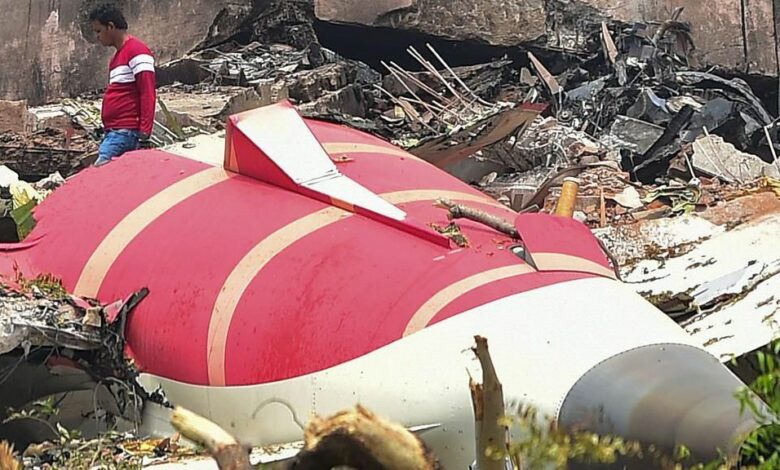
India’s Aircraft Accident Investigation Bureau (AAIB) is still considering whether or not flight data and cockpit voice recorders of the Air India flight that crashed last Thursday should be exported abroad for decoding and analysis.
A minimum of 270 individuals, the majority of whom were passengers, lost their lives when the Boeing 787-8 Dreamliner aircraft crashed barely a minute after it departed from Ahmedabad airport in western India. Several media sources had reported that the black boxes are being exported overseas, but the Ministry of Civil Aviation clarified that no decision has been made.
The ministry stated that the AAIB will decide on where to analyze a “due consideration of technical, safety, and security considerations”. Both pairs of Enhanced Airborne Flight Recorders (EAFRs) – the “black boxes” – have been recovered from the crash site of the Boeing 787 by investigators.
These two units, which capture flight data and cockpit voice, were recovered on 13 and 16 June. The plane model has two such pairs to help with detailed analysis. Data recorders record with great accuracy the gear and flap lever positions, thrust levels, engine performance, fuel flow and even fire handle operation.
Information on the plane’s “black boxes” can be employed to reconstruct the last moments of the flight and establish the cause of the accident. Yet, other media sources stated that the recorders were seriously damaged by the fire that engulfed the plane following the accident, that the data would be hard to pull out in India and that the government was set to ship the recorders to the US.
Former AAIB accident investigator Captain Kishore Chinta said one set of recorders could be also dispatched to the US “to compare the data downloaded in India with that given to the National Transportation Safety Board (NTSB)”.
He said that even though the new Delhi AAIB lab was opened in April, “it’s unknown whether it is fully functional for EAFR data downloads”. Meanwhile, the Air India chairman has stated that one of the engines of the crashed Air India aircraft was new, whereas the other was not yet due for maintenance until December.
Speaking in an interview with the Times Now news channel, N Chandrasekaran stated that both the engines of the plane had “clean” histories. Apart from this, the airline further stated that 26 of its 33 Boeing 787-8 and 787-9 aircraft have undergone inspections, all of which have been “cleared for service”.
India’s regulator had directed Air India to carry out extra safety tests on its Boeing 787 fleet following the fatal crash as a “preventive measure”. On Thursday, the airline said it would cut its flights on 16 international routes and cancel flights on three foreign destinations from 21 June to 15 July.
“The reductions are a result of the decision to voluntarily take extra pre-flight safety checks, as well as to fit in extra flight durations due to airspace closures in the Middle East,” the airline said in a statement. The move was announced a day after the carrier temporarily cut flights flown by wide-body aircraft by 15%.