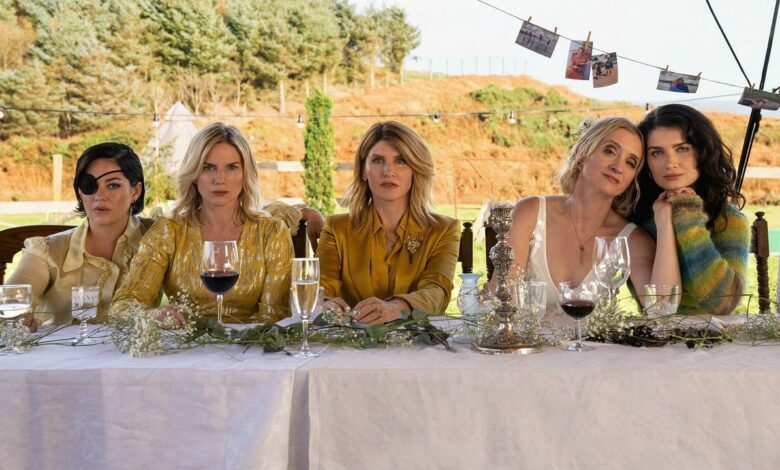
When Irish director Dearbhla Walsh began her career in Ireland during the late 1980s, there were few opportunities for emerging filmmakers. There was no work in Ireland,” says Walsh, “To dream of being a director was almost a fantasy.”
Nowadays, the image is quite different. Ireland has become a leading player in the world’s film industry over the last few years, both in creating its films and TV shows, as well as being a location and production base for foreign productions.
Walsh directed Bad Sisters, the dark comedy series for Apple TV+, which is just one of several television series filmed and set in the Republic of Ireland in recent years that, along with shows such as Normal People and Bodkin, have brought the best Irish stories to international attention. This year, actress Sharon Horgan picked up her second Emmy Award nomination in a row, for playing Eva Garvey in Bad Sisters.
Irish cinema has also received international acclaim, with The Banshees of Inisherin and The Quiet Girl both shortlisted for Academy Awards in 2023. New generations of Irish talent have come to the fore, such as Saoirse Ronan and Paul Mescal. I think Ireland’s having a moment,” Walsh claims, “Irish people feel more confident. They’re able to write from home and sell stories about Ireland.”
The film and television industry delivers over €1bn ($1.2bn/ £845m) per annum to the Irish economy, and directly supports the equivalent of about 10,000 full-time employees. That’s the finding of a report from Screen Ireland, the state-backed development agency for the Irish film industry.
Walsh, who is currently in Los Angeles filming Apple TV+’s new drama series Margo’s Got Money Troubles with Michelle Pfeiffer and Nicole Kidman, has established an internationally acclaimed career as a director. With Bad Sisters, Walsh confirms that she enjoyed the chance to tell a story from an Irish viewpoint. “It was extremely thrilling for me to come home and tell a story that I truly felt I got,” she states.
The development of the Irish film business has been credited to three decades of continued investment, backing and training as well as free tax incentives. The Irish government provides a standard 32% tax relief for film, television and animation, one of the highest in the world. How this is done is that Irish film production businesses can recover 32% of their cost of production against their business tax liability. The equivalent rate in California is 20%.
US actor Rob Lowe shared recently that “it’s cheaper to bring 100 people to Ireland” than to shoot in Los Angeles. His hit US quiz show, The Floor, is recorded in fact in the Irish town of Bray, 20km (12 miles) south of Dublin.
Lower-budget Irish films, meanwhile, receive an even greater tax relief of 40%, which was introduced in May 2025. And the Irish government has increased Screen Ireland’s budget for each year by 3.3% to a record €40.85m (£34.41/ $47.77m) in 2025.
“Our vision for Ireland is that it’s a home for screen storytelling at the top, and a top European hub for film-making,” says Désirée Finnegan, Screen Ireland CEO. “But above all, we think of it as a home for the film-makers and story makers themselves.”
Irish film producer Alan Moloney, executive producer on the Irish-British-Canadian production Brooklyn (2015), states that Screen Ireland’s investment has been successful for two reasons.
Firstly, it has been strategically investing in indigenous talent. Secondly, it has brought in international productions, like Netflix series Wednesday, which recently emerged as the largest international production to ever shoot in Ireland.