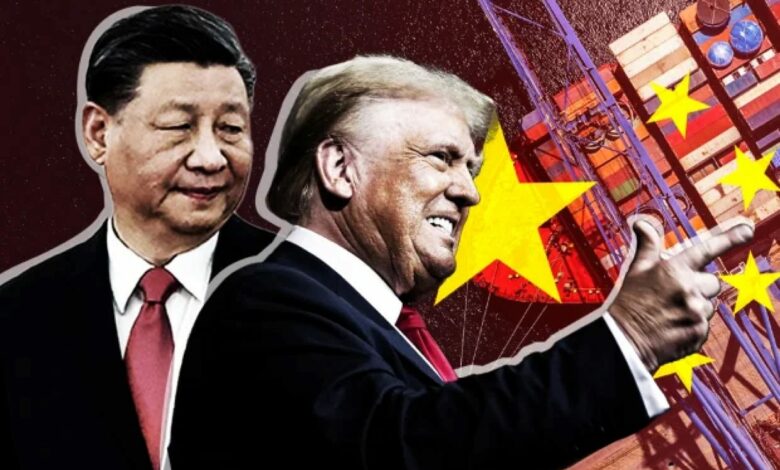
The policy of the US under the Second Donald Trump Administration has seen significant shifts, with America losing tech superiority to China, which is now positioning itself to become from follower to leader.
In spite of President Trump’s promises to enhance American superiority in artificial intelligence (AI) and biotechnology, recent policy steps threaten to sap US leadership at the very moment that China is racing ahead. Trump’s government has laid across-the-board curbs on the export of sensitive chip design software and high-end semiconductors to China in a bid to starve Beijing of the means to create world-leading AI.
But such restraints have led China to double down on domestic innovation, stepping up the pace of developing native AI chips and large language models, and working towards autonomy in major technologies.
Meanwhile, US funding freezes and cuts for biomedical research, particularly at the NIH, are sending shudders down the spines of experts, who fear that this will silence early-stage biotech innovation and let China dictate the pace in the life sciences.
China currently runs more clinical trials than the US and is quickly emerging as a cornerstone in international drug development, selling discoveries to US companies and capitalizing on a decade of national strategy to drive out biopharma.
While the US is tightening regulation and cutting public spending, it may be ‘shooting itself in the tech foot,’ potentially losing ground to China in biotech and AI at a pivotal time in the race for global innovation.
The globe is witnessing a significant shift in science leadership: China surpassed the US in the number of clinical trials. This is a key time in the international race for global leadership in biotechnology. China’s ascension is due to decades of government investment, numerous trained researchers holding PhDs, and increased application of artificial intelligence (AI) in research.
These are the things that have enabled China to transition from imitating others to taking the lead in biotech innovation. The Wall Street Journal documents that Chinese firms, once producing only replicas of Western drugs, now produce new therapies and sell them to multinational drug giants.
A turning point came when Pfizer signed a recent agreement with China’s 3SBio Inc. Pfizer agreed to license a cancer drug named SSGJ-707 for more than $6 billion. The agreement includes a $1.25 billion initial payment, up to $4.8 billion in payments contingent on the progress of work and a $100 million stock investment into 3SBio.