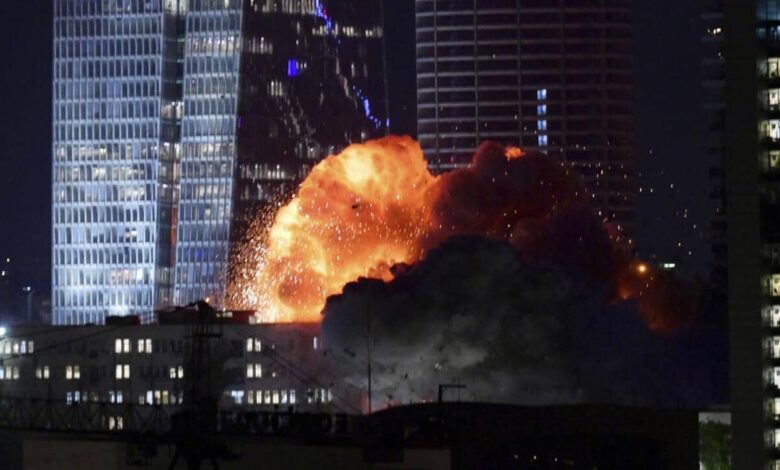
In a dramatic turn of events, Israel’s recent air attack on Iran has been said to have obliterated the Natanz above-ground enrichment facility, causing contamination issues. International Atomic Energy Agency (IAEA) chief Rafael Grossi made this revelation while speaking in an emergency UN Security Council session held in New York on Friday. He appealed to both Israel and Iran to show restraint in order to avoid a deeper regional conflict.
Grossi emphasized the need to protect nuclear facilities and said, “Nuclear facilities should never be attacked regardless of the context or situation, as it would harm people and the environment.” He said contamination from radiological and chemical has been discovered at Natanz, where Iran had been enriching uranium to 60 percent. But he said the contamination is “under control with proper measures” and the IAEA is ready to deploy nuclear security experts if needed.
UN Undersecretary-General for Political Affairs Rosemary DiCarlo seconded Grossi’s call for restraint, recalling that “a peaceful solution through negotiations remains the most effective way to provide for the peaceful character of Iran’s nuclear programme.” She warned against the dangers of adding fuel to the conflagration, with far-reaching implications for the world.
The 15 members of the UN Security Council convened at Iran’s request following Israel’s assault on some Iranian nuclear facilities and military installations at the start of Friday morning, including assassinating senior military officers and nuclear scientists. Iran’s UN Representative, Amir Saeid Iravani, called the attacks a “declaration of war” and an “attack on international order” and said that 78 individuals were killed and over 320 were wounded.
Iravani held the U.S. responsible for providing both intelligence and political backing for Israeli actions, claiming the U.S. “shares full responsibility” for the consequences. “Supporting Israel today is supporting war crimes,” he said.
The U.S. delegate, McCoy Pitt, ruled out any military action in the attacks but defended them as legitimate self-defense on behalf of Israel. He warned that “the consequences for Iran would be dire” if Iran were to attack U.S. citizens or installations in retaliation and called on Iran’s leadership to think about negotiations at present.
Israel’s UN ambassador, Danny Danon, called the attack on Iran’s nuclear sites “an act of national preservation,” stating that Iran was only days away from being able to amass enough fissile material to make a number of bombs. “This operation was carried out because the other option was unimaginable,” Danon stated, questioning how long the international community wanted Israel to wait before acting.
At the same time, Iran launched salvoes of ballistic missiles against Israeli targets in a retaliatory strike. Iravani reiterated Iran’s “inherent right of self-defense” and promised a “decisive and proportionate” counter to Israel’s actions.
Russia’s UN ambassador, Vassily Nebenzia, condemned Israel’s actions as “driving the region towards a big-scale nuclear disaster.” He labelled the strike as gross UN Charter and international law violation regardless of Israel’s pretext.