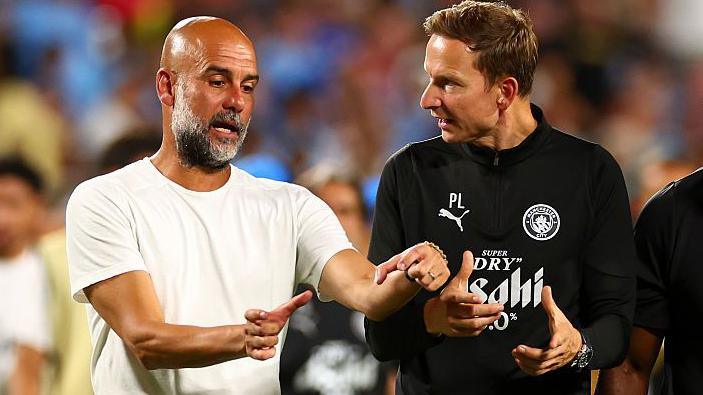
In early June, the second-most influential coaching figure of Liverpool under Jurgen Klopp joined Guardiola’s staff at Manchester City as his right-hand man. In truth, it was a bigger story than it got, not least because taking on Pep Lijnders – a man to whom most day-to-day training has been attributed in the Klopp era, and much of the German’s tactical development beyond Borussia Dortmund – indicates that Guardiola is looking at making a wholesale tactical change.
But what’s most impressive is that those tactical adjustments will be made with the huge influence of a coach who sat with Klopp discussing ideas such as counter-pressing and pressing in vertical lines, on ideas that were the antidote to Guardiola’s renowned positional play.
That dichotomy is exaggerated, however. Klopp and Guardiola took from each other, and their respective highs at Man City and Liverpool virtually blend into each other in a perfect marriage of Klopp’s energy and Guardiola’s discipline.
On the one hand, Klopp’s ‘heavy metal’ approach was tempered by an understanding of area control; on the other, Guardiola applied Klopp’s concepts to adjust to the Premier League’s physicality. But Lijnders, as with Klopp, cares more than Guardiola about high-intensity, aggressive attacking football and what happens when the ball is switched.
Until now. Because on the outside, the appointment looks to affirm that Guardiola believes Premier League football is going in the direction of the traditional Kloppites. And he’s correct. It was previously true that Guardiola’s territorial smothering would pin back weaker opponents, but as the middle-class sides improved, those who were brave enough to press energetically and interrupt the build-up play began to reap the benefits.
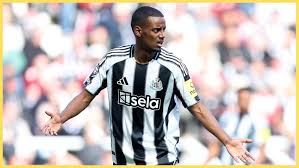
They pushed back in so literal a sense that pressing energetically and optimising transitions swept across the division, and even Guardiola found himself struggling to hold things together with slow passing and stringent marking. Modern football is the way Liverpool, Bournemouth, Brighton and Newcastle play nowadays,” Pep Guardiola explained to TNT Sports a few months ago. “Modern football is not positional. You have to ride the rhythm.”
It’s a massive claim from the man whose ‘positional play’ approach to tactics roughly dominated the sport over the last 15 years, but it’s right. In the last five years, direct attacks and fast breaks are increasing, while PPDA – a measure of pressing intensity and frequency, lower score higher pressure – is decreasing.
When Guardiola uttered those lines about contemporary football, he was already starting to try out an increasingly direct playing style. Comparing their 2023-24 to 24-25 seasons, City’s possession share fell from 65.5% to 61.3% and their overall number of fast breaks increased from 22 to 30, up 36%.
Most notably, we saw increased long balls from Ederson to get around the opposition high press and increased direct dribbling through the lines from January arrival Omar Marmoush. Marmoush, appearances to the contrary, was the initial signing of Man City 2.0: the reboot that will push Guardiola, Lijnders and City in a more Kloppian direction. More players in that vein have followed.
Rayan Cherki and Tijjani Reijnders have joined from Lyon and AC Milan, respectively, and both signings, as with Marmoush, signal more ball carrying through the lines and fewer tic-tac passing triangles. In other words, Cherki, Reijnders, and Marmoush are the type of players who like to take the rhythm for a ride.
The statistics here are stark. In comparison with Man City’s three most frequently employed central midfielders of 2024-25, Cherki, Reijnders, and Marmoush tallied significantly higher for ‘progressive carries’ (a ball carry of at least five metres towards the goal of the opponent) and ‘attempted dribbles’.
Booking Rayan Ait-Nouri also points to Klopp-esque – or Lijnders-esque – football, as having primarily used central midfielders or centre-backs as the full-backs over the last two seasons – that clear sign of control, order, and discipline – Guardiola has decisively shifted course.
Ait-Nouri is perhaps the most attacking full-back in Europe. Like the other three 2025 additions we have covered, he finished second amongst Premier League defenders in dribbles completed last season (63) and sixth amongst full-backs for progressive carries (89).
But more significantly, he finished in the top three amongst defenders for goal contributions (11), expected assists (5.5) and touches in the opposition box (96). Ait-Nouri’s signing informs us that Guardiola has had enough of shipping midfielders into the side and is sacrificing some control for more desperate, vertical attacking football.
Just like that, Manchester City fans can go from worrying about their team’s slow and passive football to wondering how such an explosive attacking pair as Ait-Nouri and Jeremy Doku could work together on the left, or how Marmoush and Cherki will fit into the same attacking midfield space.
They will be left with more questions than answers before the 2025-26 Premier League season is underway, because the majority of their summer signings – on the pitch, and in the technical area – simply don’t conform to the typical Pep type. Guardiola is tinkering with something different. With Lijnders in tow, it may be his most incisive left turn yet.