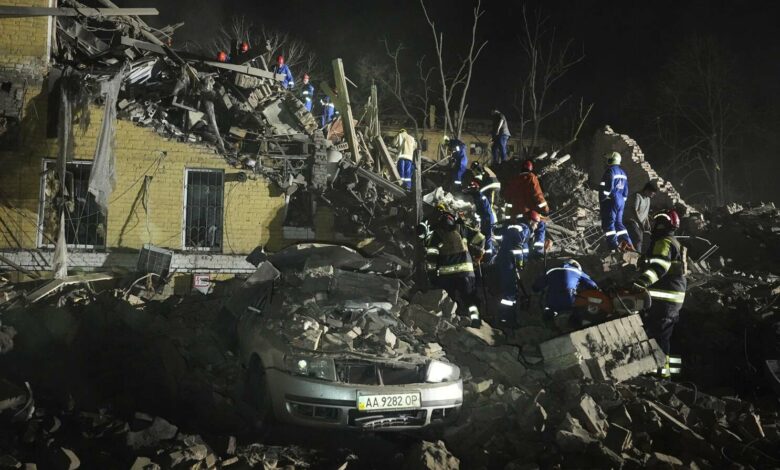
Even Povarenkov stood in front of a line of police tape defining the public from the intensive search and rescue efforts surrounding his building. He gazed upwards at what remained of his flat, in a suburb outside the Ukrainian capital city of Kyiv. His windows were gone, his balcony on the point of collapse.
Personal belongings lay scattered in the walkways below. Bedsheets and towels draped from the branches of trees. A cruise missile struck this mundane residential block in the Solomianskyi district early on Tuesday morning, probably at a speed of around 500mph. The explosion blew up 35 apartments and gutted one section of the building.
By Wednesday afternoon, 23 bodies had been discovered among the rubble. Throughout Ukraine, at least 30 had been killed in the strikes, and all but two of them in Kyiv. The strike on Povarenkov’s apartment building was part of a massive barrage launched by Russia – a total of over 440 drones and 32 missiles, according to Ukraine’s air force.
The shelling devastated the capital for nine hours, from midnight to late in the morning. It was one of the worst assaults on Kyiv since the invasion of Ukraine started. Povarenkov, who is 43 and works in a warehouse, gazed down from his destroyed apartment. His face was grazed and cut everywhere and one of his eyes was badly bloodshot. He could not see out of it.
He was in bed when the missile struck, he told Reuters. His elderly mother was sleeping in the next room. There was heat, fire, and smoke,” he said, describing the enormous impact close to his wall. “I lost consciousness. When I came around, I could hear my mother screaming.”
Neighbours assisted Povarenkov in breaking down his twisted door and fetching his mother out of the apartment. Other survivors were crawling out into the ruins of the destroyed building. People were screaming, children were weeping,” said 60-year-old pensioner Arcadiy Volenchuk. “It was absolute chaos.”
Outside, residents attempted to navigate a safe path through smouldering automobiles and falling wreckage. Everything was burning,” reported Alla, 69, a schoolteacher. “The gas tanks in the automobiles were blowing up. Shattered glass was raining down from above, with chunks of concrete and tiles.”
Povarenkov’s mother was flown to intensive care, he said, with two cracked collarbones, lacerations to both eyes and severe internal injuries that needed surgical repair. She was among over 100 injured in the city. Serhii Dubrov, the director of the 12th Kyiv City Clinical Hospital and an anesthesiologist, felt the bombardments start at around midnight.
His hospital alone would have taken in 27 patients within a matter of hours, he explained. They suffered soft tissue damage, cuts caused by shattered glass, and vessel damage. There was traumatic brain damage and internal chest damage. One had a severed femoral artery – we were able to fix it. The worst of the worst was a woman with an open head injury.
“These are the types of injuries we experience from these types of attacks. The patients at Dr Dubrov’s hospital were between 18 and 95, he added. Three were in their 90s. Strikes such as these, on apartments, can be especially hazardous to the elderly and sick, unable to quickly run to a basement shelter.
Oleksandr Bondarchuk, 64 and disabled, who lived in an apartment near the point of impact, was unable to get to the shelter. He stayed in bed in terror, he reported. It took Bondarchuk an hour after the attack to carefully make his way down to the bottom floor. “It was awful,” he said. “Everything was destroyed.”
Some of them whose flats were badly damaged managed to take refuge with relatives or friends. Others were not that lucky. “This is all I have,” Bondarchuk reported.