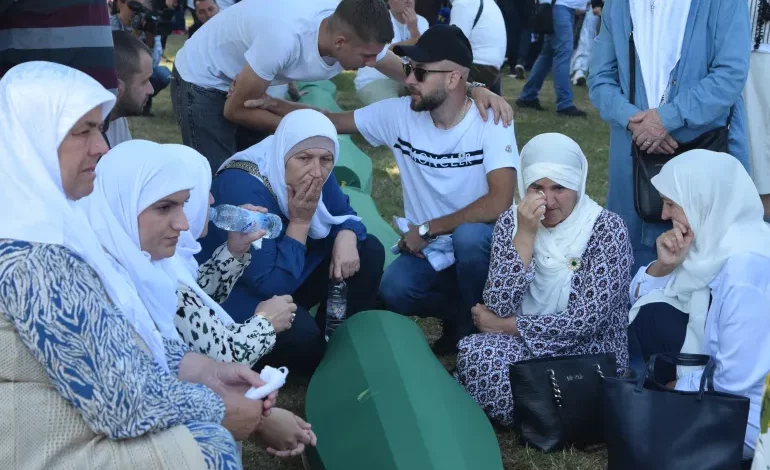
Seven additional victims of the 1995 Srebrenica genocide perpetrated by Bosnian Serb troops were interred on Friday’s dismal 30th anniversary. Potocari, Bosnia and Herzegovina – Thousands of individuals assembled in a green valley in which white gravestones speckle the landscape to commemorate 30 years since the Srebrenica genocide on Friday.
Seven of the 1995 genocide victims whose bodies were found only last year from mass graves discovered in Liplje, Baljkovica, Suljici and Kamenicko Brdo, were laid to rest on Friday during the solemn anniversary. Few remains of one of the victims, 34-year-old Hasib Omerovic, were discovered and dug up from a mass grave in 1998, but his family postponed burying him until now in hopes of retrieving more.
Zejad Avdic, 46, is the brother of one of the victims who is being buried. Senajid Avdic was only 19 when he died on July 11, 1995. His body was found in October 2010 at a location in Suljici, one of the villages besieged that day by Bosnian Serb forces.
“When I heard the news, initially I couldn’t – I didn’t – dare inform my mother, my father. It was too difficult,” Avdic said in an interview with Al Jazeera about when he heard that part of his brother’s remains were discovered.
On July 11, 1995, Bosnian Serb troops invaded the Srebrenica enclave, a demarcated United Nations-safe zone, overwhelming the Dutch UN battalion in residence. They took at least 8,000 Bosniak men and boys away from their wives, mothers and sisters, murdering them on a mass scale.
Thousands of men and boys tried to flee into the surrounding woods, but the Serb forces pursued them along the mountain roads, shooting and capturing as many as they could. Women and children were expelled from the city and surrounding villages by bus. Thousands of people had turned out for the victim’s memorial day on Friday, which started with a joint Islamic prayer – men, women and children bowing together amidst the gravestones.
Following the prayer, the coffins of the victims, who have been identified through extensive DNA testing, were carried into green coffins covered by the Bosnian flag. The coffins were placed on recently dug graves. At each location, squads of men approached to take turns burying the caskets with earth, shovelling from adjacent heaps in a hushed finish to the ritual.