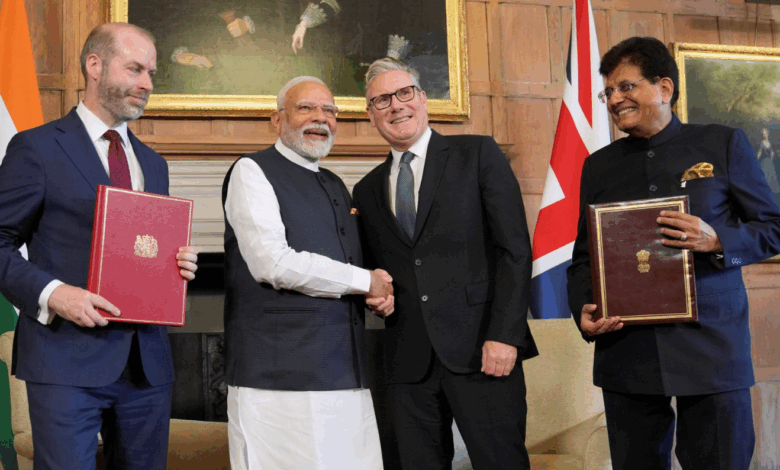
Indian Prime Minister Narendra Modi signed a free trade agreement with Prime Minister Sir Keir Starmer, which will bring a multi-billion-pound export boost. Cars and whisky from the UK will be less expensive to ship to India and Indian jewellery and textiles will be less expensive to ship to the UK under the agreement. The agreement took three years to finalize and also pledges a new India-UK agenda to fight illegal migration.
Critics had warned that the agreement would undermine British workers with longer social security terms, but UK Business Secretary Jonathan Reynolds defended this as “completely wrong” and Indian workers temporarily seconded to Britain would receive the same terms as were already extended to many other nations.
Addressing the signing at the UK prime minister’s country retreat, Chequers, Sir Keir described the UK-India agreement as “the largest and most economically significant” trade deal made by Britain since it left the EU. This deal is now signed, sealed, delivered,” he said.
“The UK has been negotiating such a deal for decades, but it is this government that delivered it, and with it, we’re making an extremely powerful statement that Britain is open for business, and that is already creating huge confidence.”
The pact will generate over 2,200 British jobs throughout the nation, stated Sir Keir, as Indian companies grow in size in Britain and British businesses win new Indian business ventures. Sir Keir also stated that a trade agreement was “not the extent or the limit of our cooperation with India”, a nation with which the UK has “unique ties of history, of family and culture, and we want to further strengthen our relationship”.
Modi described what he referred to as “a blueprint for our shared prosperity”. On the one hand, Indian textiles, footwear, gems and jewellery, seafood, and engineering goods will get better market access in the UK.
“On the other hand, people and industries in India will be able to access products made in the UK, such as medical devices and aerospace parts, at affordable and attractive prices. The UK government says the deal – announced in May after years of negotiations – will boost the British economy by £4.8bn a year.
The agreement was okayed by the Indian cabinet earlier this week, but has not yet been agreed by the UK parliament and is expected to take at least a year to come into effect.
The UK currently imports £11bn worth of goods from India, but the reduced tariffs agreed will help reduce the cost of Indian exports, including for parts used in high-value manufacturing. Indian manufacturers should also be able to access the UK market for hybrid and electric vehicles.
Tariffs for UK exports to India will be reduced from 15% to 3%, helping British businesses to sell more goods in India. Whisky exports to India have had their tariffs halved, from 150% to 75%, putting the UK one step ahead of foreign rivals in accessing the Indian market, with the tariff falling further to 40% by 2035.
Both prime ministers have also agreed to closer cooperation in the fields of defence, education, climate, technology and innovation. Improved intelligence sharing and operational co-operation will also aid in addressing corruption, serious fraud, organised crime, and illegal migration.
This involves agreeing on a new sharing arrangement for criminal records, which will support court proceedings, assist with the keeping of accurate watchlists, and facilitate the enforcement of travel bans.
The agreement has not provided the UK with as much access as it would have desired to India’s legal and financial services sectors, and negotiations remain ongoing on a bilateral investment treaty to safeguard British investments in India and vice versa.
The two countries are also still negotiating UK proposals for a high-carbon tax on industries, which India feels could unfairly target its imports. The Indian government received a longer-term exemption on national insurance contributions and referred to this as “an unprecedented achievement” when the agreement was reached in May.
The deal will result in employees of Indian businesses who are temporarily seconded to the UK, and employees of UK businesses who are temporarily working in India, only contributing towards social security in their home nation, instead of both.
But the UK government emphasised we already have mutual “double contribution convention” arrangements with 17 other nations, such as the EU, the US and South Korea.