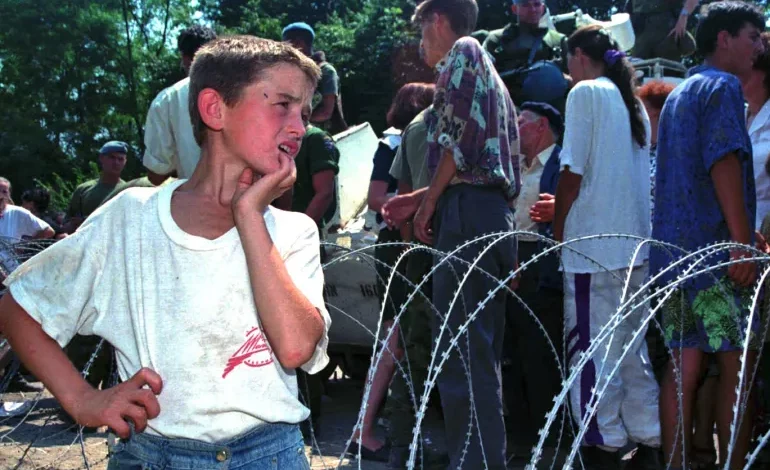
In the course of a genocide that claimed over 8,000 lives, they crawled on slush, walked through jungles, and evaded bullets and bombs. They lost most of their family members. And they won’t let the world forget.
He had recently turned a teenager. Raised in the village of Sebiocina, Srebrenica municipality, near the border with Serbia, Avdic was able to describe the distinction between grouped and scattered settlements.
He learned how one might determine the direction of north or south by observing on which side of a tree the moss grew and how to locate constellations and orient oneself with the North Star.
“I did not learn it for survival,” Avdic, age 47 now, would go on to write in his memoir. “I learned it because I loved it. But during the spring of 1995, three years into a war that still mars the Balkans, he would find himself living in the landscape of eastern Bosnia, wading through woods with 8,000 other Bosniak men and boys, struggling to survive.
Avdic was then 17 and residing in a refugee camp managed by the United Nations in the Slapovici valley, south of Srebrenica, a small town in eastern Bosnia situated in a deep valley along the Drina River, which traditionally marked a natural border with Serbia. Srebrenica, then, was a town with only 6,000 people and one that was locally famous for its ancient silver deposits, which had given the place its name – srebro is Bosnian for silver.
The UN camp, constructed on previously unoccupied land, housed over 3,000 displaced Bosniaks, indigenous South Slavic Muslims of Bosnia and Herzegovina, who resided in lines of Swedish-provided wooden huts. It had no electricity, no plumbing and never adequate food.
Bosnia was a youthful nation at the time, having just gained independence following Yugoslavia’s dissolution, having voted for independence in a public referendum on March 1, 1992. Bosnia was ethnically mixed – approximately 44 per cent Bosniak, 31 per cent Serb and 17 per cent Croat – so it was one of the most multiethnic republics of ex-Yugoslavia.
By that time, Bosnian Serbs had declared what they would refer to as Republika Srpska, a notional quasi-state which the community’s political leadership desired to extricate from Bosnia, supposedly to protect its interests.
It was only a month afterwards, on April 6, that Bosnian Serb armies, supported by Serbia, began a war to conquer land and drive out non-Serbs towards that end. Towns near the border were bombed, civilians driven out, and families such as Avdic’s were forced to flee.
His family, father Alija, mother Tima, and three younger sisters, would be displaced several times during the war: initially from their home in Sebiocina, subsequently from temporary shelters in Srebrenica town, before they arrived in the refugee camp at Slapovici.
In 1993, following a Serb attack on a school playground that resulted in 56 deaths, several of them children, and injured over 70, the area of Srebrenica and surrounding villages were made a UN “safe area” by the UN Security Council along with five other cities and towns in Bosnia.
The statement called for an “immediate halt to armed attacks by Bosnian Serb paramilitary forces against Srebrenica” and for Serbia and Montenegro, then known as the Federal Republic of Yugoslavia, to immediately halt the provision of military weapons to the Bosnian Serb paramilitary forces. But the Serb shelling of the town and surrounding villages never let up.