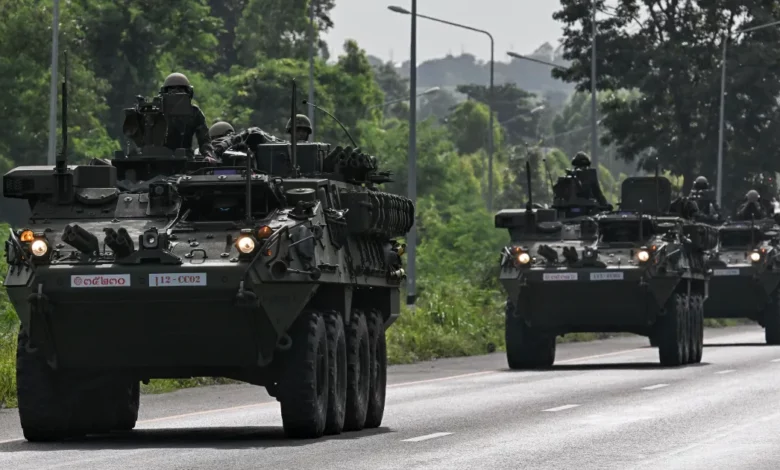
Skirmishes between Cambodian and Thai soldiers along their contested frontier have killed a minimum of 12 individuals, Thai officials report. The conflict represents a renewal of a dispute between the two South East Asian neighbours that has stretched over more than one hundred years.
The majority of the dead were civilians from three Thai provinces, Thailand’s army said, adding that several people were also injured. Cambodia has not confirmed if it had any casualties.
There were crossfire exchanges early on Thursday, each side blaming the other for having started the fighting. It quickly escalated with Thailand accusing Cambodia of rocket attacks and Bangkok launching air raids against Cambodian military targets.
Thailand has sealed its border with Cambodia, and Cambodia has downgraded the level of its relations with Thailand after accusing its military of deploying “excessive force”.
The two nations have ordered their citizens along the border to vacate the zones, with Thailand relocating 40,000 civilians to safe zones. The clashes are quite serious. We’re in the process of evacuating,” said Sutian Phiwchan, a resident of Ban Dan district in Thailand’s Buriram province along the Cambodian border.
Thai officials reported that 11 civilians – an eight-year-old and a 15-year-old among them – and one military officer have been killed in the Surin, Ubon Ratchathani and Srisaket provinces. Thailand and Cambodia have reported different accounts of what occurred.
Thailand asserts that it started when Cambodia’s military used drones to patrol over Thai soldiers along the border. Cambodia maintains that the war started after Thai soldiers broke a previous agreement and moved on a Khmer-Hindu temple close to the border.
The conflict has its origins in over a century, when the borders of the two countries were demarcated following the French occupation of Cambodia.
Hostilities became official in 2008, when Cambodia attempted to have an 11th-century temple situated in the disputed territory declared a Unesco World Heritage Site – an act that was greeted with red-hot anger by Thailand.
There had been periodic confrontations over the years in which soldiers and civilians were killed on either side. The most recent tensions escalated last May after one Cambodian soldier was killed in a confrontation. This dropped bilateral relations to an all-time low in over a decade.
Both countries have, in the last two months, imposed restrictions on each other along their shared border. Cambodia prohibited Thai imports like vegetables and fruits, and halted importing power and the internet.
Both nations have also increased troop deployment along the border in recent weeks. Thailand’s acting premier Phumtham Wechayachai confirmed that its conflict with Cambodia is still “delicate”, and needs to be handled sensitively and by international law.
Cambodian Prime Minister Hun Manet declared his nation wishes to end the conflict peacefully – although adding that it has “no option” but to “reply with armed force to armed aggression”.
Intense fighting across the two nations has receded fairly fast. But whereas it seems the ongoing fighting is not likely to escalate into a full-scale war, both nation do not have leaders with sufficient power and authority to withdraw from this confrontation.
Hun Manet, son of an erstwhile strongman, has not yet established his power, and Hun Sen, his father, seems willing to escalate this confrontation further to polish his nationalist image. In Thailand, there is a precarious government coalition led by another ousted strongman, Thaksin Shinawatra.
Thaksin thought that he was close friends with Hun Sen and his family, and felt let down by Hun Sen’s move to release a confidential discussion that resulted in his daughter, Paetongtarn Shinawatra, being suspended as prime minister.