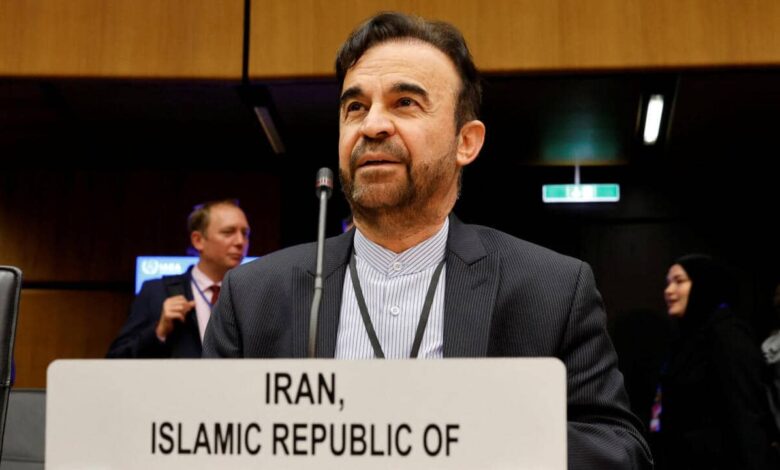
The Board of Governors of the United Nations nuclear watchdog has passed a resolution condemning Iran’s efforts to defy international nuclear safeguards, which has provoked an instant response from Tehran.
The decision, endorsed on Thursday, garnered 19 votes, three against and 11 abstentions. One of the key issues raised in the resolution is Iran’s failure to give plausible explanations on finding traces of uranium at undeclared locations, even after thorough searches by the International Atomic Energy Agency (IAEA).
Based on the resolution text, Iran’s repeated inability to fully comply with the IAEA since 2019 on undeclared nuclear materials and activities have been defined as non-compliance with its commitment under its deal with the UN agency.
In reply, Iran’s Foreign Ministry and the Atomic Energy Organization of Iran (AEOI) made a joint announcement to build a new uranium enrichment plant in a secure area, declaring that further steps would be announced later on. The AEOI also said that Iran would replace first-generation centrifuges at the Fordow nuclear facility with more advanced sixth-generation ones, indicating a resumption of nuclear enrichment.
Iran’s Press TV cited the foreign ministry as claiming that the IAEA resolution is not technically or legally valid. Interestingly, Russia, China, and Burkina Faso were some of the nations which voted against the resolution.
Al Jazeera’s Hashem Ahelbarra reported from Vienna, highlighting the resolution as a significant diplomatic development, marking the first accusation against Iran for breaching its non-proliferation obligations in nearly two decades. He warned that Iran faces a limited timeframe to respond to the resolution or risk severe repercussions, including increased isolation and sanctions.
In a separate move, Israel’s foreign ministry demanded firm action from the international community in reaction to the resolution. The IAEA vote comes as Oman’s Foreign Minister Badr Albusaidi announced that the U.S. and Iran will hold a sixth round of discussions over Tehran’s advancing nuclear program this Sunday.
Al Jazeera’s Tohid Asadi reported in Tehran that the talks in Oman to come are bound to be affected strongly by the recent IAEA resolution. He added that Iran warned the UN that if the resolution translates into sanctions, it might re-think joining the Treaty on the Non-Proliferation of Nuclear Weapons, making negotiations with America more difficult.
The quest for a new nuclear accord is still a diplomatic priority for U.S. President Donald Trump and Middle East envoy Steve Witkoff. While Trump recently spoke optimistically about the negotiations, he recently stated that he is “less confident” an agreement can be reached. He reiterated his opposition to allowing Iran to acquire nuclear weapons, amidst growing speculation that Israel could strike Iranian nuclear sites.
Moreover, there were reports that Israeli Strategic Affairs Minister Ron Dermer and Mossad head David Barnea will meet with Witkoff before U.S.-Iran talks take place in Oman. Iran, on Wednesday, threatened to bomb the U.S. military bases within the region if war is to break out, while the U.S. allegedly evacuated non-emergency personnel from various Middle Eastern nations amidst the escalation of tensions.