On Thursday, tensions between Thailand and Cambodia boiled over into a fatal fight at the border. At least 12 Thai citizens, the vast majority of them civilians, have died, Thai officials have reported. How many individuals – if any – are dead on the Cambodian side is unknown. Both sides are accusing the other of instigating the escalation, which allegedly started with border gunfire.
Thailand has accused Cambodia of then firing rockets, while Bangkok carried out air strikes on Cambodian military targets. This is not a recent dispute. In fact, the argument between Thailand and Cambodia dates back more than a century, when the borders of the two nations were drawn after the French occupation of Cambodia.
Things turned ugly in 2008, when Cambodia attempted to list an 11th Century temple in the disputed territory as a Unesco World Heritage Site – an attempt that was greeted with inflammatory protest from Thailand.
There have been intermittent skirmishes over the years which have seen soldiers and civilians on both sides being killed. The most recent tensions escalated last May after a Cambodian soldier was reported killed in a confrontation. This sent bilateral relations to their lowest level in over a decade.
Both nations have imposed border restrictions on each other in the last two months. Cambodia prohibited imports from Thailand like fruits and vegetables, and halted imports of power and internet services.
Both nations have also increased troop deployment at the border in recent weeks. Thailand’s National Security Council (NSC) asserts that shortly after 07:30 local time (00:30GMT) on Thursday, the Cambodian military sent drones to patrol Thai soldiers at the border.
Soon, Cambodian soldiers equipped with rocket-propelled grenades assembled on the border. Thai soldiers on the other side tried to negotiate through shouting but failed, said the NSC spokesman, adding that the Cambodian soldiers began firing at approximately 08:20, prompting the Thai side to return fire.
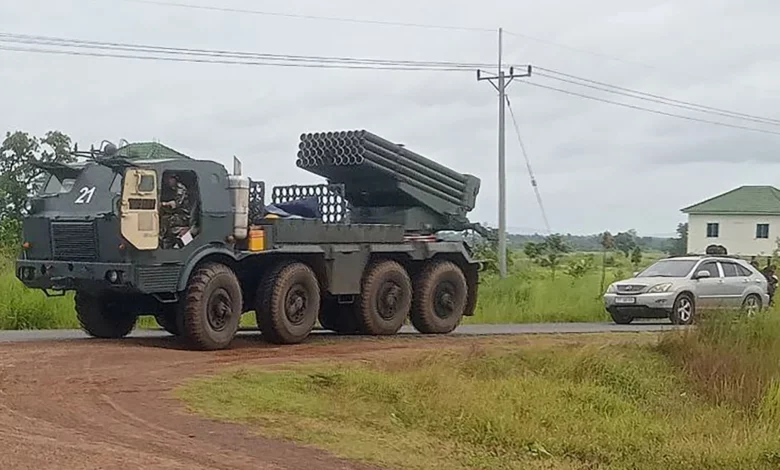
Thailand has accused Cambodia of using heavy weapons such as BM-21 rocket launchers and artillery that resulted in damage to houses and government buildings including a hospital and a petrol station on the Thai side of the border.
Cambodia, on the other hand, states that Thai troops had started the fighting at approximately 06:30, when they broke an earlier agreement by advancing on a Khmer-Hindu temple close to the border and encircling it with barbed wire.
Thai troops subsequently sent out a drone shortly after 07:00, and fired “into the air” at approximately 08:30, Cambodian Ministry of National Defence spokesperson Maly Socheata said. At 08:46, Thai troops “pre-emptively” fired on Cambodian forces, giving them no alternative but to invoke their right to self-defence, the Phnom Penh Post newspaper quoted Socheata.
Socheata also accused Thailand of sending too many troops, employing heavy artillery and conducting air raids on Cambodian land. Phumtham Wechayachai, the acting Thai premier, stated that the relationship between Thailand and Cambodia is still “delicate” and has to be handled with sensitivity, and in accordance with international law.
Cambodian Prime Minister Hun Manet stated that his nation seeks to settle the conflict by peaceful means and that it has “no alternative” but to “reply with armed force against armed aggression.” Although serious exchanges of fire have previously occurred, they subsided comparatively rapidly – a course of action our correspondent Jonathan Head believes will again be taken. But he cautions, there is no leadership with the muscle and the confidence to step back from this conflict in both nations currently.